

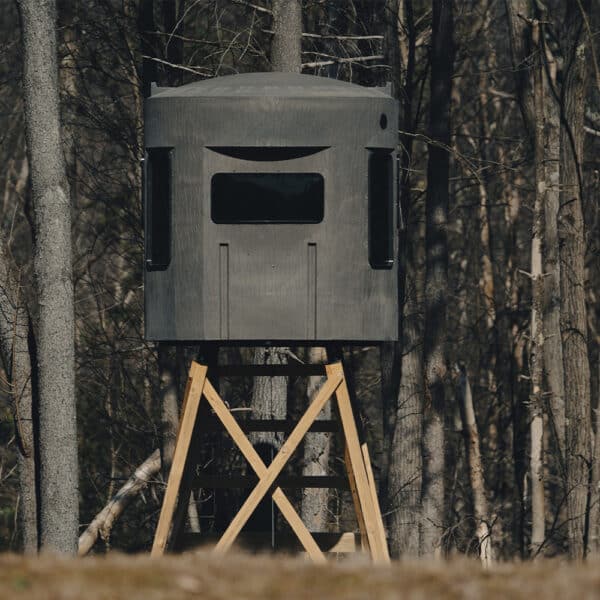
Once you find the perfect hunting spot, it can be tempting to lock in on that one area. But if you hunt it too often, you’ll end up overhunting the area and sabotaging yourself. The best way to avoid overhunting your favorite spots early in the season is to make sure your scent is always contained, switch up your spots, and put enough days in between.
Keep Your Scent Contained
One of the fastest ways to alert deer to your presence in a hunting area is to forget to eliminate and mask your scent. A deer’s nose is unbelievably powerful, so powerful that it’s hard for scientists to estimate just how much. They will be able to detect you from miles away if you’re not careful. They have an inordinate amount of olfactory receptors, at least 300 million, in their nose that can register, remember and identify different scents. You don’t want to be on the losing side of a bet with a deer’s nose. You can mitigate your risk by using a scent-eliminating spray before you approach your blind and when you leave. Our Stump blinds are designed to keep scent contained inside the blind with tightly sealed doors and windows and heavy insulation. Our windows open silently, so you can keep your scent contained as long as possible before you open the blind to take a shot.
Switch Up Your Spots
To help avoid hunting pressure, switch up the spots you hunt from. You should have a rotation of a few different hunting sites you use so that you’re not excessively pressuring any one site. Our Stump blinds are incredibly easy to move thanks to the ski base, so you can use the same blind at multiple spots. You can also get one blind to leave up permanently at each spot. Some public lands don’t allow you to leave blinds up overnight, so be sure to check your local regulations before doing so.
You don’t need to abandon your favorite section of public hunting land completely to avoid overhunting. It could even be as simple as switching to a spot further back into the woods. If there are a significant number of hunters at the opening of the hunting grounds, the deer will naturally move away from them, back into the woods. All you have to do is be where they’re going to exit the crowd and you’ve still made use of your favorite land while using a different spot.
Put Some Time In Between
Whether you rotate between a few sites or use just one, make sure you’re putting enough time between visits. If you hunt the exact same spot every day of the week at the exact same time, you’ll become patternable and the deer will eventually get wise to your habits. Keep a rotation, keep moving, and keep the deer guessing.
Our Stump blinds can help you avoid overhunting by giving you scent protection and making it easy to move your blind to a new hunting spot. Keep a rotation of your favorite spots, know when it’s time to move, and you’ll set yourself up for a successful fall hunting season.
How do you avoid overhunting your favorite spots to lessen hunting pressure? Do you use your Stump blinds to move around? Let us know in the comments below!


Doe Management: Why September is a Great Time to Start Herd Control
How the 'Feedbank 300' Keeps Deer Close as Food Sources Shift