

Though deer season has ended in Minnesota, it is currently still beaver, bobcat, fox, opossum, rabbit, raccoon and squirrel season. The Minnesota DNR website lists out the exact dates for each of the wild game listed above. You will also find the daily limit and possession limits for each small game species on page 47 of the Minnesota DNR’s hunting regulations document. So, you can still enjoy winter hunts by hunting small wild game or extend your deer season by traveling to other states that have longer seasons. Check out our tips for winter wildlife tracking and learn how to identify signs in the snow.
Footprints
One of the most obvious signs you’ll be able to track in the snow is the wildlife’s footprint. You’ll be able to see hoofprints of deer, hogs, or whatever other wild game you’re tracking.
If you’re tracking deer with snow on the ground, you can test how recently a print was made by pressing your fingers into the middle of the print. If the snow immediately dissolves under your hand, that’s a good indicator that the print is warm and that it was made recently.
You can tell that a print is older if there is debris covering the print or collected in the dent. This indicates that the print has been there long enough for the wind to blow things into the area.
If you’re tracking bobcats, look for round pad marks. Bobcat prints will look a lot like a regular cat’s, just larger. Don’t try to find claw marks, bobcats won’t usually walk with their claws drawn. You can tell the difference between a bobcat print and a coyote print in the snow because a coyote’s print will be narrower, with the toes closer together. In thick snow, bobcats will walk with their hind prints landing directly over their front prints, so the prints will be spaced about a foot apart.
Bedding Areas
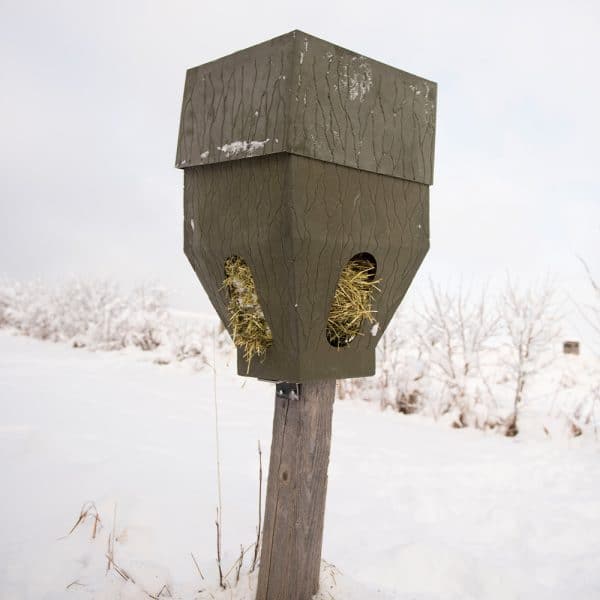
Bedding areas for deer will be easier to spot in the winter, as there will be large circular dents in the snow. As the leaves disappear from the trees, the deer herd won’t have heavy brush to use as bedding areas, so take note of areas with woody browse. Woody browse is a deer’s preferred diet during winter, so find acorn trees and trees with plenty of things dropped onto the ground. Deer will also still gravitate toward cornfields. Look for bedding areas near these food sources. If you’re still feeding the deer from your Feedbank Gravity Deer Feeder, continue to monitor the area leading to your feeder.
Stump Blinds
When you’re done tracking your chosen wild game in the snow, set up your Stump blind at the end of the fresh track marks. Our Stump blinds are easy to move around a property, even in the snow, thanks to the ski base. The insulated blind will also keep you warm while you wait for the game you just tracked to reappear.
Multi-Function Hand Warmers
While you’re out in the elements tracking signs, hold onto our Multi-Function Hand Warmers. You’ll receive two warmers that have two charging ports each and heat up to 131 degrees. So, if you’re using your phone to track your path on a map, you can keep your phone charged while you walk around the woods.
How do you identify signs in the snow when you’re tracking wildlife in winter? Let us know in the comments below!
How to Maintain Your Firearm in Cold, Wet Conditions
Winter Predator Hunting: Techniques for Success